

What Does It Cost to Build a Modern Data Center in 2026?


.png)
The year 2026 marks a significant milestone in the development of data centers. AI workloads are pushing power density to new levels, utilities are tightening capacity, and scale expectations keep rising. That combination changes how owners budget, how sites are selected, and how early design choices ripple through final pricing.
If you want predictable outcomes, you need cost clarity before land acquisition, interconnection requests, or schematic design. This is where the real economics show up: power delivery timelines, redundancy targets, and cooling strategies often decide the budget long before concrete is poured. Data centers sit among the most capital-intensive real estate builds because every decision supports uptime, efficiency, and growth.
What Is the Average Cost to Build a Data Center in 2026?
Budgets in 2026 depend less on square footage and more on usable power, redundancy, and compute density. A helpful starting point is to estimate by megawatt, then validate with local utility, labor, and material conditions.
At a high level, the cost to build a data center splits into two different tracks: traditional enterprise-style facilities and AI-optimized builds that require heavier electrical, cooling, and IT infrastructure.
Cost Per Megawatt (MW): The New Benchmark
For 2026, JLL forecasts an average global data center shell-and-core construction cost of approximately $11.3 million per megawatt, up from $10.7 million per megawatt in 2025. This is a global research benchmark, not a bid for a particular market or facility. JLL states that tenant technology fit-out is excluded; AI-focused equipment and related fit-out can add substantially to the total. Use installed IT power capacity, redundancy, construction scope and local utility conditions to compare projects, and confirm precisely what each cost-per-MW quote includes.
AI-Optimized Data Centers: A New Cost Tier
AI workloads can change both the base building and the tenant technology package because they require higher rack power, more complex cooling and substantial compute infrastructure. JLL notes that tenant technology fit-out for AI infrastructure can cost as much as $25 million per MW in addition to its shell-and-core construction benchmark. That is an upper-end research observation, not an extra cost that applies to every project. When comparing AI and conventional facilities, show the base building, utility infrastructure, cooling scope and installed technology as separate line items, with no category counted twice.
Data Center Construction Cost Breakdown (Per MW and Per Square Foot)
A realistic budget gets clearer when you separate the major cost buckets and identify which ones scale with MW versus square footage. This breakdown helps stakeholders spot risk early and negotiate scope with fewer surprises.
Transparent budgeting matters because a data center is a mission-critical project where reliability targets and future expansion planning are baked into construction decisions.
Shell & Core Construction Costs
Shell-and-core pricing needs a written inclusions schedule. The JLL 2026 global average of $11.3 million per MW relates to data center shell-and-core construction, while tenant-owned technology fit-out is excluded. Do not treat that benchmark as a shell-only civil or building-envelope price and automatically stack every base-building electrical and mechanical item on top. Instead, identify what has been included in the construction benchmark, what is supplied by the utility, what is base-building infrastructure and what remains within the tenant technology fit-out.
Electrical Systems (The Largest Cost Driver)
Electrical systems frequently account for 40 to 50% of the total budget, and $280 to $460 per square foot is a common range cited for electrical-heavy scopes. Substations, switchgear, redundancy configurations, and grid interconnection often carry long lead times and high contingency.
This is where experienced data center contractors can protect schedule and budget through procurement planning, staged energization strategies, and constructability reviews.
Mechanical Systems and Cooling
Mechanical scope often represents 15 to 20% of total costs, with $125 to $215 per square foot used in many estimates, depending on the design approach. AI workloads are accelerating the adoption of liquid cooling and high-density HVAC strategies, which change piping, heat rejection, and control complexity.
Cooling decisions influence the cost to build a data center because they affect everything from floor layout to electrical sizing and water service requirements.
Interior Fit-Out and AI Infrastructure
Traditional IT fit-out typically focuses on white space readiness, containment, power whips, and commissioning alignment. AI-specific interior fit-out can add $25M per MW or more once you include high-density distribution, coolant delivery, and specialized monitoring.
This category is growing fast because it sits at the intersection of uptime expectations and performance, making it a major driver of data center construction costs.
Total Construction Cost Per Square Foot
Cost per square foot can help cross-check a data center budget, but it should not replace capacity-based estimating. One site may need large electrical yards and mechanical plant to support high IT loads, while another may have similar building floor area and much lower power density. Start by defining commissioned IT megawatts, facility redundancy, cooling architecture, equipment ownership and utility scope. Then use the proposed building area to calculate a project-specific cost per square foot, documenting whether land, electrical infrastructure and tenant technology are included.
How Much Does It Cost to Build a 50 MW Data Center?
A 50 MW project is a useful reference point because it sits in the mid-to-large-scale range where utility coordination, procurement timing, and phased delivery become central. The numbers below illustrate why planning assumptions must be explicit from day one.
Treating a 50 MW build as a mission-critical project means budgeting for commissioning depth, redundancy, and operational handoff, not simply construction completion.
Standard 50 MW Facility Cost Estimate
A 50 MW facility multiplied by JLL's illustrative 2026 global shell-and-core average of $11.3 million per MW produces approximately $565 million for that benchmarked scope. It does not mean every 50 MW facility will cost $565 million, nor should core systems already included in the benchmark be added again. Build the full project estimate from clearly separated categories: the quoted shell-and-core scope, off-site utility and interconnection obligations not included there, land and soft costs, contingency, and tenant technology fit-out. Only add costs demonstrated to sit outside the selected baseline.
50 MW AI-Optimized Facility
For an AI-optimized 50 MW build, costs can climb beyond $1B depending on compute density and cooling architecture. In many markets, power infrastructure becomes the limiting factor rather than building size, especially where substation capacity and utility timelines are constrained.
This is why the cost to build a data center in 2026 increasingly reflects grid strategy and equipment availability, not a simple price per square foot.
How Many Acres Do You Need for a Data Center? (And Why Land Costs Matter)
Land planning ties directly to expansion potential, setback requirements, utility corridors, and stormwater management. Acreage needs also shift based on whether you are building a single facility or planning a campus with multiple phases.
Land selection impacts the cost of constructing a data center because a site that looks affordable can trigger expensive off-site work for power, road access, or grading.
Typical Land Requirements by Scale
Data center site acreage depends on the proposed IT load, building levels, setbacks, outdoor mechanical and electrical equipment, stormwater controls, utility corridors, access roads and planned expansion. A single-building facility and a multi-phase hyperscale campus can need dramatically different footprints, even at similar initial megawatt capacity. Work backward from the engineering plot plan and the utility's interconnection needs before estimating acres. The ability to deliver power on schedule may be more important than a low land price.
Land Cost vs. Power Availability Tradeoffs
Cheap land without power is frequently unusable for modern builds because interconnection timelines and substation scope can dominate the schedule. Location decisions affect total cost through utility upgrades, transmission proximity, and the complexity of delivering redundant feeds.
Engaging data center contractors early can help align site feasibility with constructability and realistic utility sequencing.
Key Cost Drivers Shaping Data Center Construction in 2026
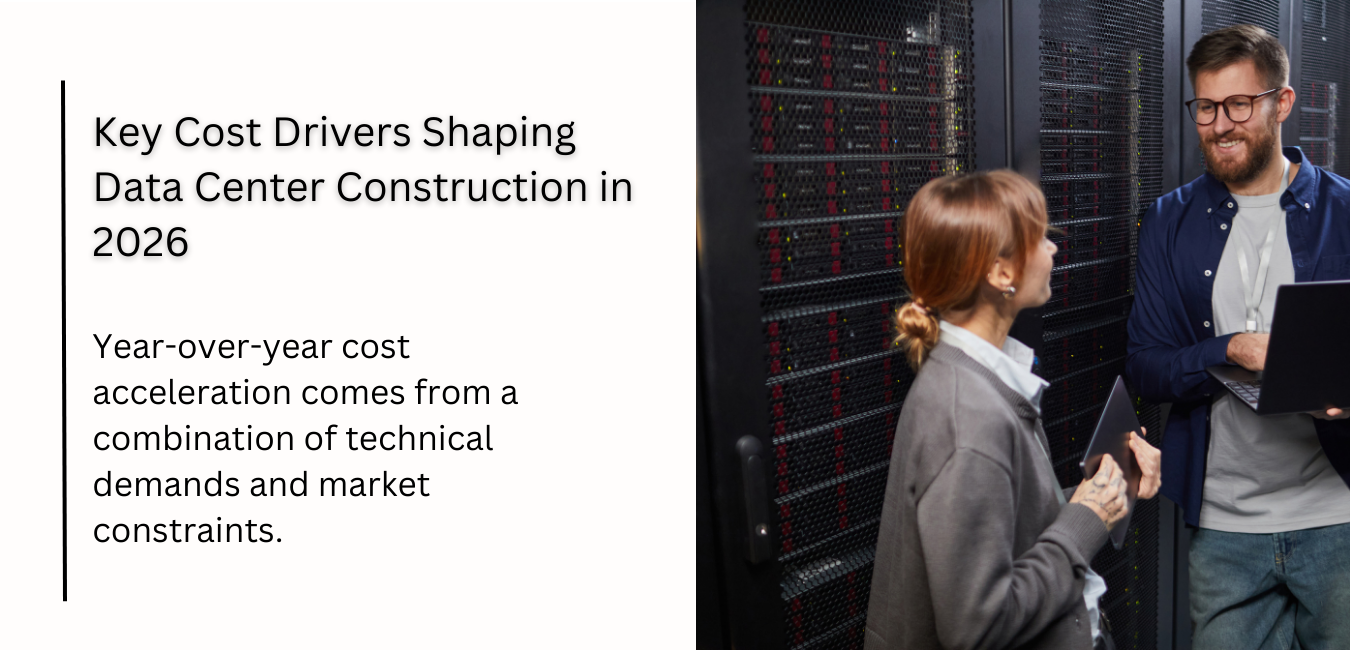
Year-over-year cost acceleration comes from a combination of technical demands and market constraints. AI density, grid limitations, and expansion planning pressures all shape the allocation of capital across shell, systems, and fit-out.
Owners who treat early decisions as part of a mission-critical project tend to get better cost predictability because scope alignment happens before procurement locks in pricing.
AI and High-Density Compute Demand
Liquid cooling, higher power loads, and specialized layouts are now common in forward-looking builds. AI has reset baseline assumptions for distribution, monitoring, and thermal management, which lifts budgets even when the building footprint stays similar.
This phenomenon directly increases data center construction cost because higher density requires higher-capacity infrastructure with tighter tolerances.
Power Access and Grid Constraints
Substation build-outs are becoming major capital expenses, and in some regions, they are the main pacing item. Proximity to power infrastructure can outweigh land price because it shortens the interconnection scope and reduces the risk tied to utility upgrades.
In 2026, the cost of building a data center often tracks the complexity of power delivery and redundancy design.
Scale and Future Expansion Planning
Hyperscale designs frequently require upfront investment to avoid expensive retrofits when new phases come online. Experienced data center contractors can reduce costly redesigns by validating phasing, equipment yards, and backbone infrastructure early.
Expansion planning reduces overall data center construction cost volatility by limiting rework and change orders as capacity grows.
Data Center Trends in 2026 That Are Driving Costs Higher
Trends shaping 2026 are not abstract; they show up as line items in budgets and as risks in schedules. Facilities are being designed around AI readiness, while development shifts toward regions that can actually deliver power.
These shifts change how stakeholders forecast the cost to build a data center because they affect site choice, staffing, and procurement strategies.
Shift Toward AI-First Facilities
Traditional enterprise data centers are becoming obsolete for many high-density workloads. Capital intensity is increasing faster than square footage because infrastructure per hall is heavier, and commissioning requirements are stricter.
This trend increases the costs of constructing data centers even for projects that appear similar on a site plan.
Regional Power Migration
Development is moving toward power-rich regions where utilities can support large interconnections. That migration brings regulatory and infrastructure implications, including permitting timelines, community engagement, and offsite upgrades.
Those factors influence the cost of building a data center through carrying costs, schedule risks, and extended preconstruction work.
Why Choosing the Right Data Center Contractors Impacts Total Cost
Contractor selection directly affects budget reliability because sequencing, procurement, and commissioning depth are central to performance outcomes. Specialized teams understand the coordination required between civil, structural, electrical, mechanical, and control scopes.
For a mission-critical project, the wrong delivery approach can turn a clean estimate into change orders, delays, and operational compromises.
Specialized Data Center Construction Experience
General contractors often underestimate the complexity of redundancy, testing, and equipment integration. Without specialized expertise, the risk of budget overruns rises due to missed scope, underestimated lead times, and late-stage design changes.
Choosing proven data center contractors helps control the costs of data center construction by reducing rework and improving schedule certainty.
Integrated Design, Engineering, and Construction
Cost control improves when design, engineering, and construction teams coordinate early around power planning and realistic budgets. Integrated delivery typically means fewer change orders, clearer procurement ownership, and better alignment on commissioning requirements.
That coordination stabilizes the cost of building a data center by turning the unknowns into a defined scope before construction starts.
Element Homes: Applying Data Center Cost Discipline to “Homes for Intelligence”
Data center projects require specialists in power infrastructure, mechanical systems, commissioning, controls and mission-critical operations. The planning lessons from those projects are also useful in residential construction, especially when a home involves backup power, advanced climate control or substantial electrical demand. Element Homes focuses on custom residential design and construction, and we apply a similarly disciplined approach to defining scope, coordinating systems and reviewing allowances. Readers planning a commercial data center should engage firms with verified mission-critical construction and commissioning experience. For a custom residential project that involves complex building systems, our team can discuss the design and construction scope.
At Element Homes, we apply lessons from data center construction cost drivers to help our clients plan high-performance environments with fewer surprises.
Why Data Center Economics Matter for the Future of Residential Design
Rising power density, resilience needs, and technology integration are shaping high-end homes, especially where electrification, backup power, and advanced systems are expected. Applying data center-style cost transparency helps our clients understand what drives pricing and where investments create long-term value.
This mindset allows us to borrow from a mission-critical project approach without forcing commercial complexity into a home.
Leveraging Our Turnkey Model to Control Cost, Risk, and Complexity
Our single-contract, in-house team approach reduces fragmentation and cost overruns by clarifying accountability across the build. By managing architecture, permitting, land development, and construction within one process, we support tighter timelines and cleaner scope control.
Our approach is the same logic clients value when selecting data center contractors, applied by us to projects where coordination and predictability matter.
Building Smarter, More Resilient Structures Without Guesswork
At Element Homes, lessons from data center expenses translate into future-ready homes through adaptability, energy efficiency, and durability. Thoughtful planning around electrical capacity, mechanical performance, and system integration supports long-term comfort and resilience.
The result is a clearer path to value using principles proven in the cost of building a datacenter world.
Conclusion
Modern data centers rank among the most expensive assets to build, and 2026 is intensifying that reality through AI density, grid constraints, and stricter infrastructure requirements. The best cost control comes from transparency, early planning, and a powerful strategy that matches your deployment goals. Experienced data center contractors help reduce budget volatility by aligning design, procurement, and commissioning to real-world constraints.
If you are planning a high-performance residential or mixed-use project and want the same level of cost discipline used in complex infrastructure, Element Homes can help. Contact us to discuss your goals, timeline, and the right strategy to control risk and deliver a resilient build.

Related POsts
Longevity Home Design: Key Features for a Healthier Luxury Custom Home
Explore longevity home design ideas for a healthier luxury custom home, from cleaner air and better lighting to wellness spaces and durable materials.
Read moreBuilding a Luxury Custom Home in Atherton: Costs, Permits, Timelines & Design
Planning a luxury custom home in Atherton? Learn about costs, permits, timelines, tree rules, design choices, and what to review before construction.
Read more